20 July 2026
Derma Roller vs CALECIM® Stamp for Hair Loss: Which Is Better for Hair Growth?
If you've been researching hair loss treatments, hair thinning or ways to support healthier hair growth, you've probably come across both derma rollers and the CALECIM® Stamp.
At first glance, they may look similar. Both use tiny needles to create microscopic channels in the skin, but the way they work is quite different. A derma roller moves across the scalp using a rolling motion, while the CALECIM® Stamp is pressed vertically onto the skin. This difference can affect how precisely you can target thinning areas, how the device moves through existing hair and how comfortable the treatment feels.
So, which should you choose? The answer depends on your hair, your scalp, your treatment goals and how you plan to use the device.
In this guide, we'll compare the derma roller and CALECIM® Stamp, looking at their key differences, advantages and disadvantages, and how they may fit into a wider hair and scalp treatment routine.
Quick Answer: Derma Roller or CALECIM® Stamp?
Neither device is automatically better for everyone. A derma roller is an affordable and versatile microneedling tool that has been used for many years to stimulate the scalp and support the delivery of topical products. The CALECIM® Stamp is a more targeted approach to microneedling. Rather than rolling across the scalp, it is pressed vertically onto specific areas, helping to minimise sideways movement through the hair. Both devices can be used as part of a professional or at-home scalp care routine, but each has different advantages.
The best option depends on factors such as your hair length, the areas you want to target, your preferred treatment method and the products you are using alongside it.
Derma Roller vs CALECIM® Stamp: Comparison at a Glance
Feature | Derma Roller | CALECIM® Stamp |
Microneedling method | Rolling motion | Vertical stamping |
Precision | Moderate | High |
Movement through hair | May catch or pull hair if used incorrectly | Minimal sideways movement |
Comfort | Can feel scratchy for some users | Often more comfortable |
Suitable for hair-bearing scalp | Yes, with appropriate technique | Well suited to targeted areas |
Product penetration | Creates temporary microchannels | Creates temporary microchannels |
Compatible with topical products | Yes | Yes |
Best suited for | General scalp stimulation | Precise treatment and targeted areas |
Learning curve | Moderate | Relatively straightforward |
Cost | Usually lower | Usually higher |
So, What Is a Derma Roller?
A derma roller is a handheld microneedling device covered with multiple tiny needles attached to a rotating cylinder. When rolled across the scalp, the needles create microscopic channels in the skin. These controlled micro-injuries are intended to stimulate the body's natural repair response and may also help topical products penetrate the skin more effectively.
Derma rollers have been used for many years as part of different skin and scalp care routines and remain one of the more accessible microneedling options. Depending on the treatment approach, they may be used alongside topical products such as:
- Cellagen
- Numinox
- Minoxidil (read our fact sheet : Minoxidil Vs Calecim for more information)
- Growth factor serums
- Peptide-based products
However, the suitability of any topical product alongside microneedling depends on the individual product, the condition of the scalp and professional guidance.
Pros of a Derma Roller ✔ Usually less expensive ✔ Easy to purchase ✔ Widely available ✔ Can support topical product penetration ✔ May stimulate the scalp's natural repair response ✔ Suitable for a range of scalp care routines ✔ Available in different needle lengths | Cons of a Derma Roller ✘ Can catch, pull or potentially break hairs if used incorrectly, particularly with longer or thicker hair ✘ The rolling action creates sideways movement across the scalp ✘ Treatment depth can vary depending on pressure and angle ✘ It can be more difficult to target specific thinning areas precisely ✘ Devices need appropriate cleaning and periodic replacement |
And, What Is the CALECIM® Stamp?
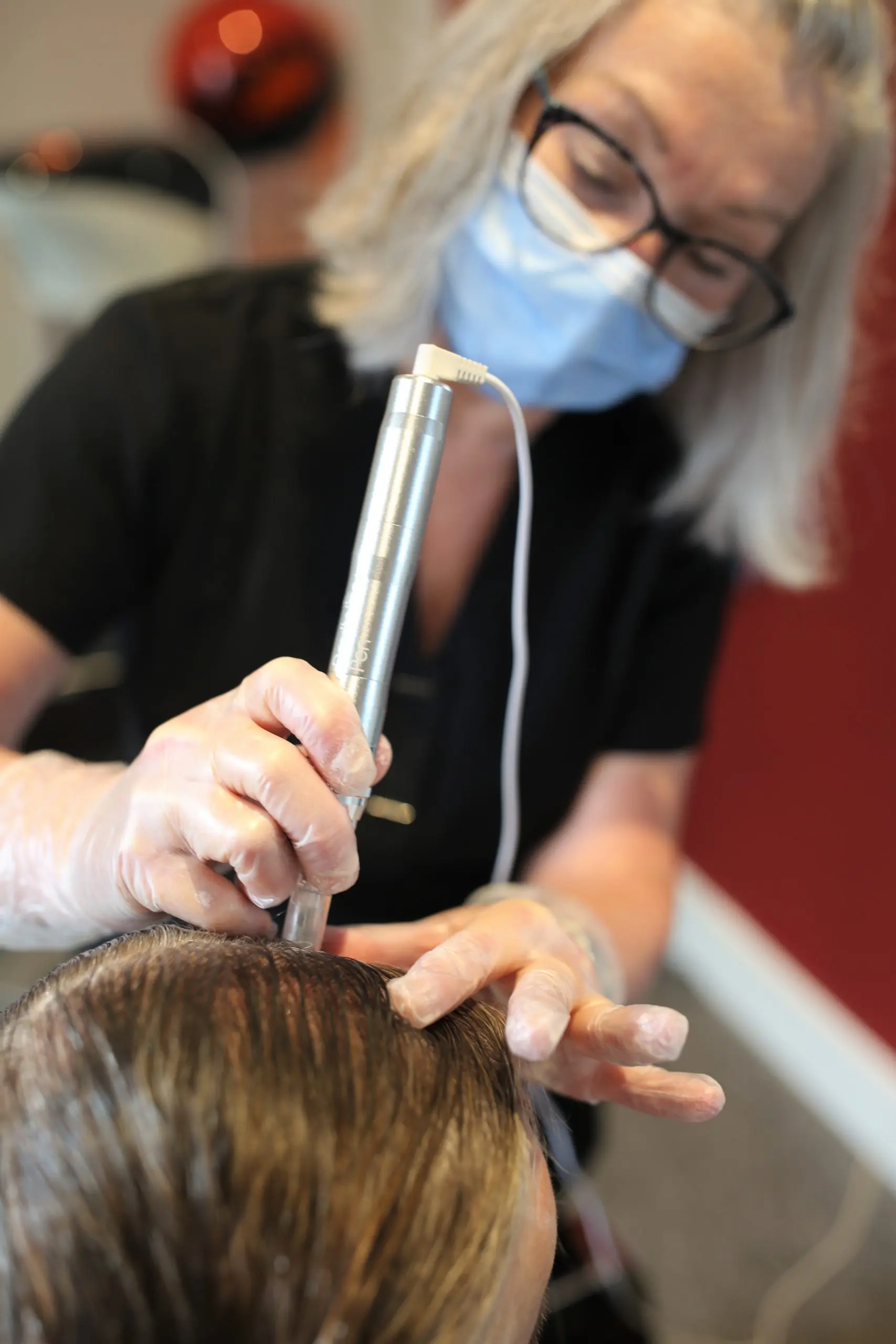
The CALECIM® Stamp uses tiny needles in a similar way to a derma roller, but instead of rolling across the scalp, it is gently pressed vertically onto the skin. This stamping action allows you to target specific areas while minimising sideways movement across the scalp. The CALECIM® Stamp was developed to complement the CALECIM® Professional Hair System, but the stamping method can also be used alongside other suitable topical scalp products.
For anyone concerned about hair thinning, the ability to work more precisely across specific areas may be particularly appealing.
Pros of the CALECIM® Stamp ✔ Precise needle placement ✔ Allows targeted treatment of specific areas ✔ Minimal dragging across the scalp ✔ Less likely to catch or pull existing hair ✔ Can be comfortable for many users ✔ Well suited to targeted thinning areas ✔ Can be used alongside suitable topical scalp products | Cons of the CALECIM® Stamp ✘ Higher initial cost ✘ Covers a smaller area with each application ✘ Treatment may take slightly longer over larger areas ✘ Still requires appropriate cleaning and replacement ✘ Some people may simply prefer the faster rolling action of a traditional derma roller |
Which Is Better for Hair-Bearing Areas of the Scalp?
One of the biggest practical differences between these two devices is how they move through the hair. A derma roller needs to travel across the scalp, which means the rolling action can potentially catch or pull existing hair if the device is not used correctly. The CALECIM® Stamp is pressed directly onto the scalp, reducing sideways movement through the hair. For people with longer or thicker hair, or those targeting specific areas of hair thinning, this may make stamping a more comfortable and manageable option. However, correct technique remains important with any microneedling device.
Which Is Better for Product Penetration?
Both devices create temporary microscopic channels in the skin, which may help topical products reach the scalp more effectively. The main difference is how those channels are created. A derma roller creates them as the device moves across the scalp, while a stamp creates them by pressing vertically into the skin. The choice between the two may therefore come down to how you prefer to work across the scalp and whether you want to target specific areas.
It is important to follow the manufacturer's guidance for any product used alongside microneedling, as not every topical product is suitable for use immediately after treatment.
Derma Roller vs CALECIM® Stamp: Which Is Better for Hair Loss?
Honestly, there isn't one universal winner!
A derma roller may suit you if you:
- Want a more affordable introduction to microneedling
- Are comfortable learning the correct technique
- Have shorter hair
- Want to work across larger areas of the scalp
- Are looking for general scalp stimulation
A CALECIM® Stamp may suit you if you:
- Have longer hair that may catch or tangle
- Want to target specific areas of hair thinning
- Prefer less sideways movement across the scalp
- Are using the CALECIM® Professional Hair System
- Prefer a more precise stamping approach
Ultimately, the best choice depends on your individual hair, scalp and treatment goals.
Can You Use a Derma Roller and CALECIM® Stamp Together?
It may be possible to incorporate different microneedling approaches into a wider hair and scalp treatment routine, but there is not necessarily a need to use both. If you are using multiple topical products or treatments, it is important to consider how they interact with microneedling and whether they are appropriate to use together.
Always follow the manufacturer's instructions regarding:
- Needle length
- Cleaning and hygiene
- Frequency of use
- Product compatibility
- Device replacement
If you're unsure which approach is right for you, professional advice can help you choose a treatment routine that is appropriate for your individual circumstances.
Which Microneedling Device Is Right for You?
Choosing between a derma roller and the CALECIM® Stamp isn't simply about deciding which device is "better". It's about finding the approach that works best for your:
- Hair length and density
- Areas of hair thinning
- Scalp condition
- Treatment goals
- Existing hair loss treatment routine
- Preferred method of application
For some people, the affordability and simplicity of a derma roller may make it the right choice. For others, particularly those with longer hair or specific areas of thinning, the precision of a stamping device may be more appealing.
If you're experiencing hair loss or hair thinning, it's also important to remember that a microneedling device is only one potential part of a wider approach to hair and scalp health. Understanding the underlying cause of your hair loss is an important first step in deciding which treatments may be appropriate.
Final Thoughts: Derma Roller or CALECIM® Stamp?
Both derma rollers and the CALECIM® Stamp offer different approaches to microneedling the scalp. A derma roller may be a practical and affordable option for general scalp stimulation, while the CALECIM® Stamp offers greater precision and less sideways movement across hair-bearing areas.
The right choice isn't necessarily about which device is "better". It's about which approach is most appropriate for your hair, your scalp and your individual treatment goals. If you're unsure which device is right for you, or you're experiencing ongoing hair loss or hair thinning, seek advice from a qualified hair loss specialist who can assess your individual circumstances and recommend an appropriate approach.
Frequently Asked Questions About Derma Rollers and CALECIM® Stamps
Can microneedling help with a receding hairline?
Microneedling is sometimes used as part of hair loss treatment approaches, but the causes of a receding hairline vary. A professional assessment can help determine what may be contributing to hair loss and whether microneedling is appropriate.
How often should I use a derma roller or CALECIM® Stamp?
The appropriate frequency depends on the device, needle length and your individual treatment plan. Always follow the manufacturer's instructions or advice from a qualified professional rather than assuming that more frequent treatment will produce better results.
Can I use a derma roller or CALECIM® Stamp on an irritated scalp?
Microneedling should not be performed over an actively irritated, infected or compromised scalp without appropriate professional advice. If your scalp is sore, inflamed or showing signs of infection, seek guidance before using a microneedling device.
Can microneedling make hair loss worse?
Incorrect technique, excessive pressure, poor hygiene or inappropriate treatment frequency may cause unnecessary irritation or skin trauma. This is why correct technique and following manufacturer guidance are important.
Is microneedling suitable for everyone experiencing hair thinning?
No. Hair thinning can have many different causes, and microneedling may not be appropriate for every person or every type of hair loss. A professional assessment can help determine whether it is suitable for your circumstances.
Can I use hair loss products immediately after microneedling?
This depends on the specific product. Microneedling temporarily changes the skin barrier, so some products may cause irritation or may not be suitable for immediate application. Always follow the product manufacturer's instructions and professional advice.